



Please select data
Human Rights Policy
Human Rights Policy of Pacific Hospital Supply Co., Ltd
1. Purpose and Scope
This Policy sets forth Pacific Hospital Supply Co., Ltd.’s (hereinafter referred to as the “Company”) firm commitment to respecting and promoting human rights. The Company recognizes the broad impacts of its business activities on society and the environment and acknowledges its responsibility as a business enterprise to respect human rights throughout the global value chain. This Policy serves as the Company’s overarching guiding principle for human rights due diligence and guides all business decisions and day-to-day operations.
This Policy applies to all departments and employees of the Company, regardless of their position or location. We prioritize our own operations and upstream supply chain and will gradually extend our efforts to downstream activities. We are committed to extending the principles of this Policy to all of our business partners, including suppliers, customers, and other business entities with which we conduct business, and expect them to uphold internationally recognized human rights standards. Together, we strive to build a responsible value chain.
2. Human Rights Commitment
The Company is committed to respecting internationally recognized human rights standards, including, but not limited to, the United Nations Guiding Principles on Business and Human Rights (UNGPs), the Universal Declaration of Human Rights (UDHR), and the fundamental conventions covered by the International Labor Organization’s (ILO) Declaration on Fundamental Principles and Rights at Work. We will pay particular attention to the following human rights areas:
(1) Labor Rights
The Company is committed to providing a fair, safe, respectful, and harmonious working environment and safeguarding the fundamental rights and interests of all employees, including:
a. Prohibition of Forced Labor and Child Labor:
The Company strictly prohibits all forms of forced labor, bonded labor, and the employment of children under the age of 15, and is committed to protecting the labor rights and interests of young workers.
b. Fair Compensation and Reasonable Working Hours:
The Company ensures that employees receive compensation that complies with applicable local laws and contractual requirements and is sufficient to meet basic living standards. The Company also complies with applicable requirements governing reasonable and lawful working hours.
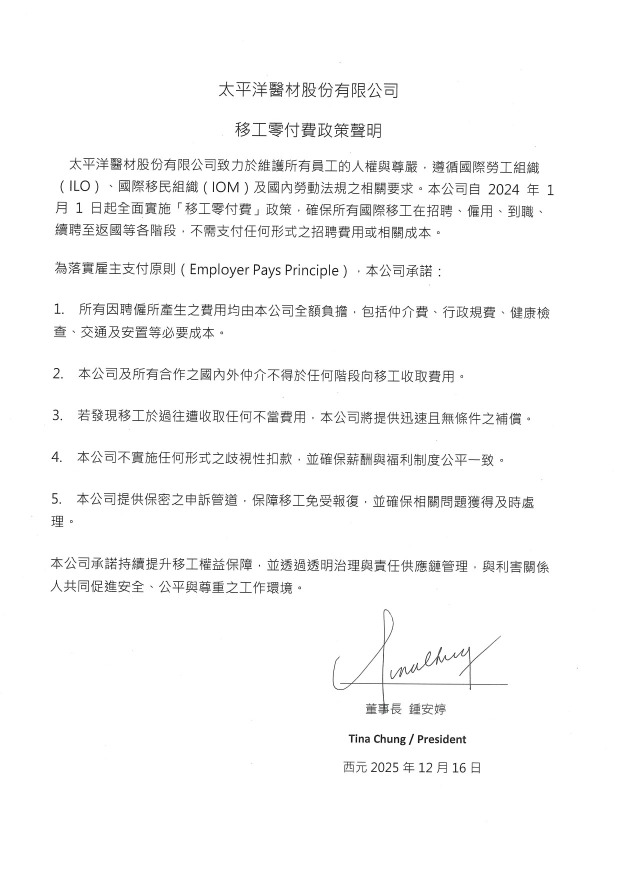
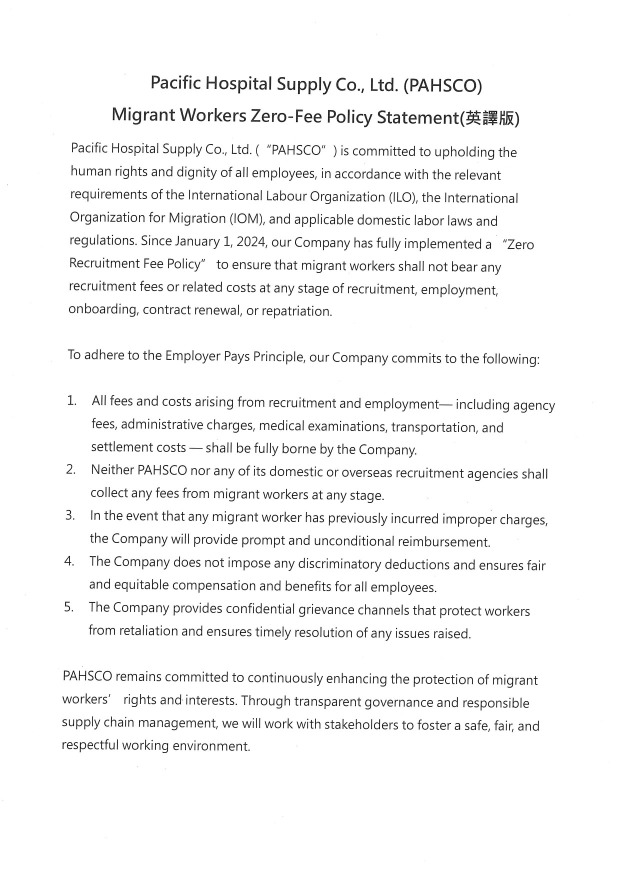
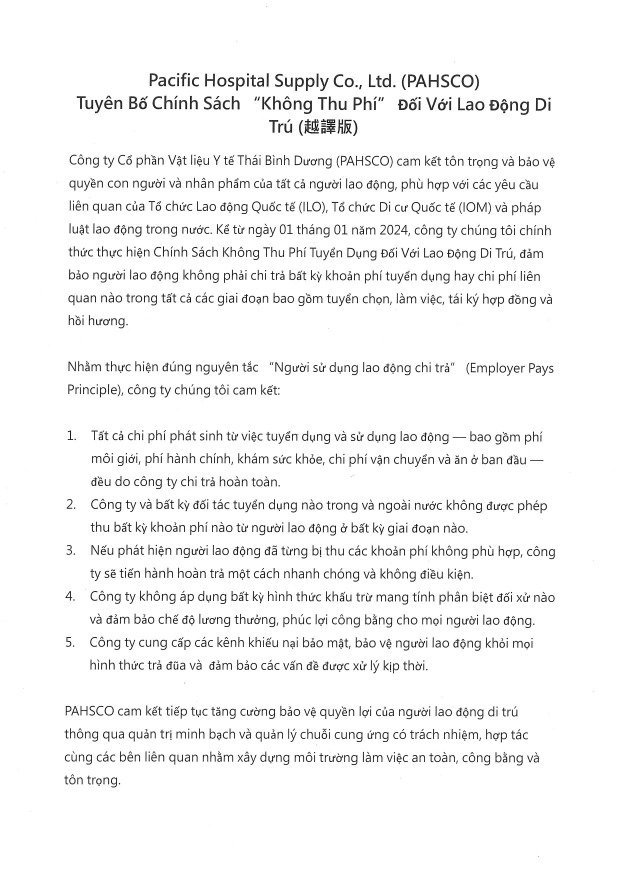
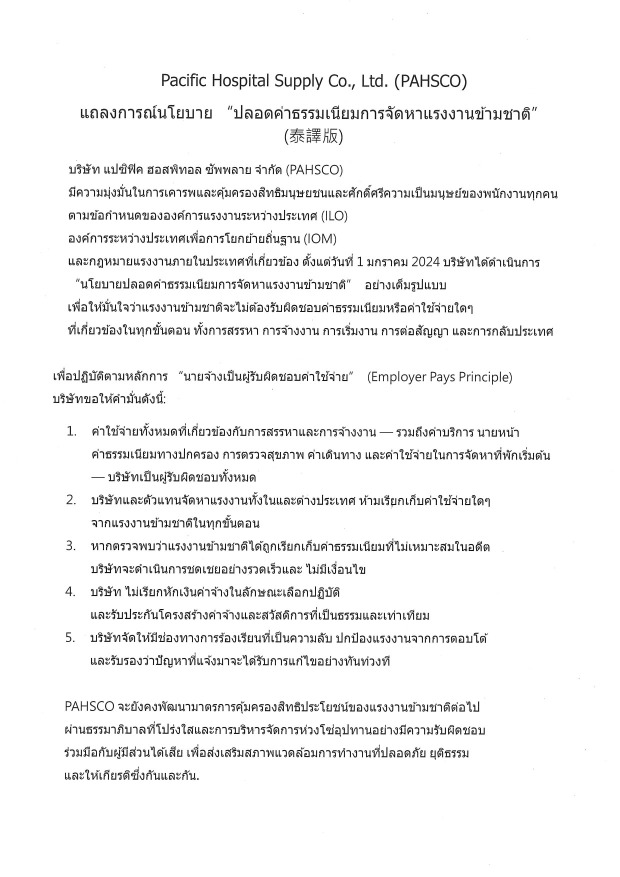
c. Fair Recruitment and Zero Recruitment Fees:
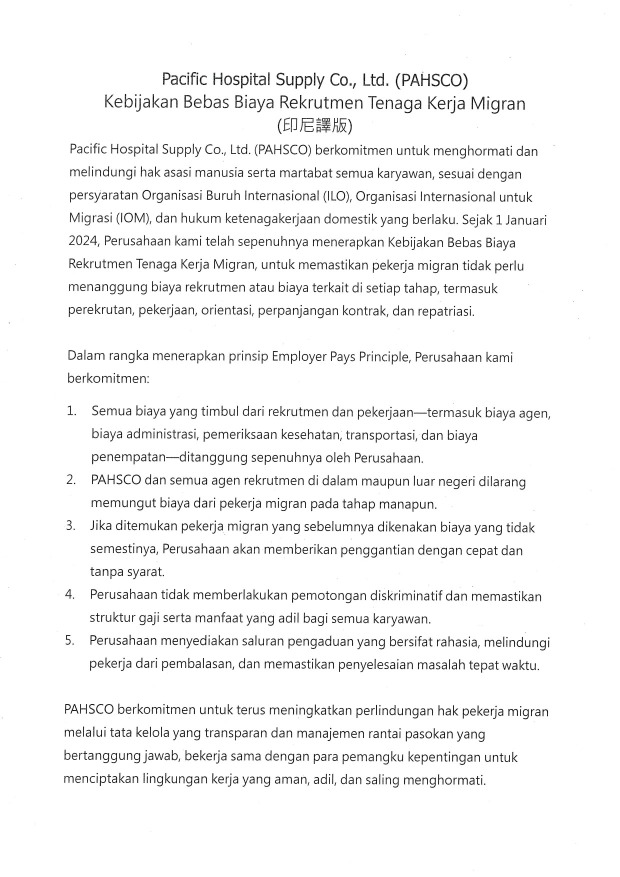
The Company shall bear in full all fees and related costs associated with the recruitment and employment of migrant workers and prohibits the transfer of such costs to workers in any form. The Company also prohibits the retention of employees’ passports, residence permits, or other personal identification documents.
d. Non-Discrimination and Equal Opportunity:
The Company provides equal treatment in recruitment, compensation, rewards, disciplinary actions, and other employment practices based on employees’ qualifications, capabilities, and experience, without discrimination on the basis of race, social status, language, beliefs, religion, political affiliation, place of origin, place of birth, nationality, gender, sexual orientation, age, marital status, appearance, facial features, physical or mental disability, zodiac sign, blood type, previous trade union membership, pregnancy, childcare responsibilities, or any other rights or characteristics protected by applicable laws.
e. Prohibition of Workplace Bullying and Prevention of Workplace Misconduct:
The Company is committed to creating a harmonious, safe, and inclusive workplace and strictly prohibits hostile conduct, workplace bullying, and other unlawful workplace misconduct, including verbal belittlement, bullying, or abuse, as well as physical assault, corporal punishment, restriction of movement, isolation, or other forms of mistreatment.
(2) Gender Equality
The Company is firmly committed to promoting gender equality and ensuring a workplace free from gender discrimination and sexual harassment. The Company provides equal opportunities for career development to employees of all genders and supports employees in achieving a balance between work and family life. Prevention of sexual harassment covers conduct occurring in the course of performing work duties, during commuting, and at accommodation facilities provided by the Company, and applies to conduct by supervisors, colleagues, and third parties. Such matters shall be handled in accordance with the Company’s applicable regulations and procedures for the prevention of sexual harassment.
(3) Occupational Health and Safety
The Company regards employees’ occupational health and safety as a top priority. We are committed to providing a safe and healthy working environment and continuously improving our safety facilities and procedures. Employees have the right to withdraw from a workplace when an emergency or disaster poses a threat to their safety and, until the incident has ended and the workplace has been confirmed safe, to refuse to resume work without fear of retaliation or any adverse treatment or disciplinary action.
(4) Freedom of Association
The Company respects employees’ right to freely choose whether to join or form a trade union, as well as their right to engage in collective bargaining. We are committed to ensuring that no employee is subject to discrimination or retaliation for currently or previously organizing or joining a trade union or participating in lawful activities related to freedom of association.
(5) Freedom of Expression and Participation
The Company encourages and respects all employees’ right to express their opinions and suggestions regarding Company affairs in an open, transparent, and retaliation-free environment, particularly on matters concerning their own rights and interests or potential human rights impacts. We will establish and maintain diverse communication channels and provide appropriate opportunities for consultation and expression regarding policies, measures, and significant changes that may affect employees’ rights and human rights.
3. Management Approach
(1) Human Rights Governance Structure
The Chairman of the Company bears ultimate responsibility for the implementation of this Policy and shall review the progress, effectiveness, and significant human rights risks associated with human rights due diligence at least once a year. The heads of departments, including Human Resources, Procurement, and Legal, are responsible for implementing human rights due diligence activities and ensuring that human rights principles are integrated into their respective departments’ day-to-day operations. They shall regularly report the relevant implementation status to the Chairman.
(2) Identification and Assessment of Adverse Impacts
The Company will continuously identify and assess, through a systematic process, the risks arising from actual and potential human rights and environmental impacts across its own operations and global value chain, including the upstream supply chain, own operations, and the use of its products or services downstream. The Company will prioritize such risks based on the severity and likelihood of occurrence of their potential adverse impacts. The results of the adverse impact assessments will be reviewed regularly and adjusted in response to changes in the internal and external environment to ensure the timeliness and comprehensiveness of adverse impact management.
(3) Supplier Assessment
The Company shall integrate human rights standards into its supplier selection, assessment, and management processes and ensure that all suppliers comply with the Company’s Supplier Code of Conduct to prevent the risk of adverse human rights impacts.
(4) Training and Education
The Company shall regularly provide all employees with training on the Human Rights Policy and human rights due diligence processes to enhance employees’ human rights awareness and their ability to identify and respond to adverse impacts.
(5) Grievance Mechanisms
The Company shall establish and maintain effective and accessible grievance mechanisms to ensure that individuals or groups who have suffered adverse human rights impacts arising from the Company’s activities or business relationships can raise grievances safely, confidentially, and without fear of retaliation, and receive timely handling and responses. Information regarding the grievance mechanisms and how to access and use them shall be communicated and publicly posted in languages that employees can understand, including the native languages of migrant workers. The receipt and handling of whistleblowing and grievance cases shall be conducted in accordance with the Company’s Whistleblowing and Grievance Handling Procedures.
(6) Remediation Mechanisms
Where the Company determines that it has caused or contributed to adverse human rights impacts, it shall promptly initiate remediation mechanisms and provide, or cooperate with relevant stakeholders in providing, appropriate remedies. Where adverse impacts are directly linked to the Company’s operations, products, or services through a business relationship, the Company shall use its leverage to encourage the relevant parties to prevent, mitigate, and remedy such impacts.
(7) Communication and Disclosure
The Company will maintain transparency regarding human rights information and regularly disclose the implementation and effectiveness of its human rights due diligence through its Sustainability Report, official website, or other relevant platforms. The Company encourages constructive dialogue with stakeholders to continuously improve its human rights practices.
This Policy sets forth Pacific Hospital Supply Co., Ltd.’s (hereinafter referred to as the “Company”) firm commitment to respecting and promoting human rights. The Company recognizes the broad impacts of its business activities on society and the environment and acknowledges its responsibility as a business enterprise to respect human rights throughout the global value chain. This Policy serves as the Company’s overarching guiding principle for human rights due diligence and guides all business decisions and day-to-day operations.
This Policy applies to all departments and employees of the Company, regardless of their position or location. We prioritize our own operations and upstream supply chain and will gradually extend our efforts to downstream activities. We are committed to extending the principles of this Policy to all of our business partners, including suppliers, customers, and other business entities with which we conduct business, and expect them to uphold internationally recognized human rights standards. Together, we strive to build a responsible value chain.
2. Human Rights Commitment
The Company is committed to respecting internationally recognized human rights standards, including, but not limited to, the United Nations Guiding Principles on Business and Human Rights (UNGPs), the Universal Declaration of Human Rights (UDHR), and the fundamental conventions covered by the International Labor Organization’s (ILO) Declaration on Fundamental Principles and Rights at Work. We will pay particular attention to the following human rights areas:
(1) Labor Rights
The Company is committed to providing a fair, safe, respectful, and harmonious working environment and safeguarding the fundamental rights and interests of all employees, including:
a. Prohibition of Forced Labor and Child Labor:
The Company strictly prohibits all forms of forced labor, bonded labor, and the employment of children under the age of 15, and is committed to protecting the labor rights and interests of young workers.
b. Fair Compensation and Reasonable Working Hours:
The Company ensures that employees receive compensation that complies with applicable local laws and contractual requirements and is sufficient to meet basic living standards. The Company also complies with applicable requirements governing reasonable and lawful working hours.
c. Fair Recruitment and Zero Recruitment Fees:
The Company shall bear in full all fees and related costs associated with the recruitment and employment of migrant workers and prohibits the transfer of such costs to workers in any form. The Company also prohibits the retention of employees’ passports, residence permits, or other personal identification documents.
d. Non-Discrimination and Equal Opportunity:
The Company provides equal treatment in recruitment, compensation, rewards, disciplinary actions, and other employment practices based on employees’ qualifications, capabilities, and experience, without discrimination on the basis of race, social status, language, beliefs, religion, political affiliation, place of origin, place of birth, nationality, gender, sexual orientation, age, marital status, appearance, facial features, physical or mental disability, zodiac sign, blood type, previous trade union membership, pregnancy, childcare responsibilities, or any other rights or characteristics protected by applicable laws.
e. Prohibition of Workplace Bullying and Prevention of Workplace Misconduct:
The Company is committed to creating a harmonious, safe, and inclusive workplace and strictly prohibits hostile conduct, workplace bullying, and other unlawful workplace misconduct, including verbal belittlement, bullying, or abuse, as well as physical assault, corporal punishment, restriction of movement, isolation, or other forms of mistreatment.
(2) Gender Equality
The Company is firmly committed to promoting gender equality and ensuring a workplace free from gender discrimination and sexual harassment. The Company provides equal opportunities for career development to employees of all genders and supports employees in achieving a balance between work and family life. Prevention of sexual harassment covers conduct occurring in the course of performing work duties, during commuting, and at accommodation facilities provided by the Company, and applies to conduct by supervisors, colleagues, and third parties. Such matters shall be handled in accordance with the Company’s applicable regulations and procedures for the prevention of sexual harassment.
(3) Occupational Health and Safety
The Company regards employees’ occupational health and safety as a top priority. We are committed to providing a safe and healthy working environment and continuously improving our safety facilities and procedures. Employees have the right to withdraw from a workplace when an emergency or disaster poses a threat to their safety and, until the incident has ended and the workplace has been confirmed safe, to refuse to resume work without fear of retaliation or any adverse treatment or disciplinary action.
(4) Freedom of Association
The Company respects employees’ right to freely choose whether to join or form a trade union, as well as their right to engage in collective bargaining. We are committed to ensuring that no employee is subject to discrimination or retaliation for currently or previously organizing or joining a trade union or participating in lawful activities related to freedom of association.
(5) Freedom of Expression and Participation
The Company encourages and respects all employees’ right to express their opinions and suggestions regarding Company affairs in an open, transparent, and retaliation-free environment, particularly on matters concerning their own rights and interests or potential human rights impacts. We will establish and maintain diverse communication channels and provide appropriate opportunities for consultation and expression regarding policies, measures, and significant changes that may affect employees’ rights and human rights.
3. Management Approach
(1) Human Rights Governance Structure
The Chairman of the Company bears ultimate responsibility for the implementation of this Policy and shall review the progress, effectiveness, and significant human rights risks associated with human rights due diligence at least once a year. The heads of departments, including Human Resources, Procurement, and Legal, are responsible for implementing human rights due diligence activities and ensuring that human rights principles are integrated into their respective departments’ day-to-day operations. They shall regularly report the relevant implementation status to the Chairman.
(2) Identification and Assessment of Adverse Impacts
The Company will continuously identify and assess, through a systematic process, the risks arising from actual and potential human rights and environmental impacts across its own operations and global value chain, including the upstream supply chain, own operations, and the use of its products or services downstream. The Company will prioritize such risks based on the severity and likelihood of occurrence of their potential adverse impacts. The results of the adverse impact assessments will be reviewed regularly and adjusted in response to changes in the internal and external environment to ensure the timeliness and comprehensiveness of adverse impact management.
(3) Supplier Assessment
The Company shall integrate human rights standards into its supplier selection, assessment, and management processes and ensure that all suppliers comply with the Company’s Supplier Code of Conduct to prevent the risk of adverse human rights impacts.
(4) Training and Education
The Company shall regularly provide all employees with training on the Human Rights Policy and human rights due diligence processes to enhance employees’ human rights awareness and their ability to identify and respond to adverse impacts.
(5) Grievance Mechanisms
The Company shall establish and maintain effective and accessible grievance mechanisms to ensure that individuals or groups who have suffered adverse human rights impacts arising from the Company’s activities or business relationships can raise grievances safely, confidentially, and without fear of retaliation, and receive timely handling and responses. Information regarding the grievance mechanisms and how to access and use them shall be communicated and publicly posted in languages that employees can understand, including the native languages of migrant workers. The receipt and handling of whistleblowing and grievance cases shall be conducted in accordance with the Company’s Whistleblowing and Grievance Handling Procedures.
(6) Remediation Mechanisms
Where the Company determines that it has caused or contributed to adverse human rights impacts, it shall promptly initiate remediation mechanisms and provide, or cooperate with relevant stakeholders in providing, appropriate remedies. Where adverse impacts are directly linked to the Company’s operations, products, or services through a business relationship, the Company shall use its leverage to encourage the relevant parties to prevent, mitigate, and remedy such impacts.
(7) Communication and Disclosure
The Company will maintain transparency regarding human rights information and regularly disclose the implementation and effectiveness of its human rights due diligence through its Sustainability Report, official website, or other relevant platforms. The Company encourages constructive dialogue with stakeholders to continuously improve its human rights practices.
President


If there is any question, please contact
Stakeholder Contacts
Executive Assistant: Tina Wang
E-mail:ir@pahsco.com.tw
Tel : +886-2-2895-5050
Fax: +886-2-2897-8282
Stakeholder Contacts
Executive Assistant: Tina Wang
E-mail:ir@pahsco.com.tw
Tel : +886-2-2895-5050
Fax: +886-2-2897-8282